About
I am a doctoral student at UPenn interested in machine learning. I develop simple algorithms with theoretical guarantees that improve the reliability of artificial intelligence systems. Currently, I am exploring applications to natural language processing, image processing, AI-for-math, and econometrics. I am grateful to be advised by Prof Edgar Dobriban and Prof Hamed Hassani. Previously, I received my bachelor's degree in mathematics from Princeton with highest honors.
Focus
In the short term, I am focused on statistical approaches to AI reliability. In the medium term, I would like to explore the mathematical foundations of AI and economics. In the long term, I hope to build AI-powered systems that enable large-scale collaboration, and that help people express their analytical and artistic creativity en masse. I also hope to develop a statistical theory of venture investing.
Contact
My email address is sunayj [at] sas.upenn.edu and my desk is in Amy Gutmann Hall. Please reach out via email or social media, I would love to learn from you. (I find collaboration much more fun than working in isolation.) My curriculum vitae can be found here.
Other academic interests
I am also fascinated by and excited to learn more about single-cell gene sequencing methods like spatial transcriptomics; structural biology methods like cryo-EM; medical imaging methods like MRI; manifold learning; non-probabilistic and geometric foundations of ML and representation learning; approximation theory for ML; leveraging data symmetry and representation theory in the design of learning algorithms (i.e., neural architectures); treating neurological diseases by analyzing EEG signals and other diagnostics; auditing the medical reasoning of clinical LLMs via statistics; AI for conservation biology; multimodal AI and virtual reality for preserving historical cultures, artefacts, and spaces; auditing AI benchmarks via statistics; optimal control for robotics, macroeconometrics, steering generative AI (LLMs, diffusion models, flow matching models); mathematical statistical mechanics and its relation to probabilistic combinatorics, random matrix theory, and ML theory; the philosophy, foundations, and history of statistics; the precise relation between hierarchical and neural representations of data; analogies between optimization algorithms and stochastic and ordinary differential equations; mathematical and statistical finance and interpretable models of general multi-agent systems like mean-field games, especially in modeling financial crises; delineating the advantages of homogeneous vs heterogeneous agent swarms; network models in statistics; how AI agents handle uncertainty and ambiguity when deployed in complex settings; how to prevent p-hacking and other statistical crimes from being committed by data science AI agents; metacognitive algorithms for improving LLM performance; design choices when learning world models; anonymization and deanonymization of personal data on social media platforms; robustness, distribution shift, and out-of-distribution generalization in statistics and ML; algorithmic primitives for LLM jailbreaking and defenses; understanding why black-box Bayesian optimization works in practice, especially for drug discovery; analogies between statistics and analytic number theory; envisioning a future of "infinite-horizon" clinical trials; natural experiments on networks; leveraging synthetic data in statistics; creating simulacra of human behavior both individual and collaborative by leveraging novel qualitative psychometric factors; the interface of statistics and entrepreneurship, especially in the context of AI evaluation and monitoring; inventing more interactive and continuous modes of human-AI creative collaboration; co-creating personalized and aesthetic educational content using AI; cheaper music education with the help of AI and robotics; rethinking educational evaluation in the age of AI; improving home and public safety via passive AI-powered monitoring systems; extreme event prediction and mitigation; simple and generalizable hacks for boosting our collective physical health, mental health, and creativity; generative user interfaces; and designing scalable and inclusive academic workflows for our collective AI-empowered future.
Latest change: The Definition of Numerical Analysis
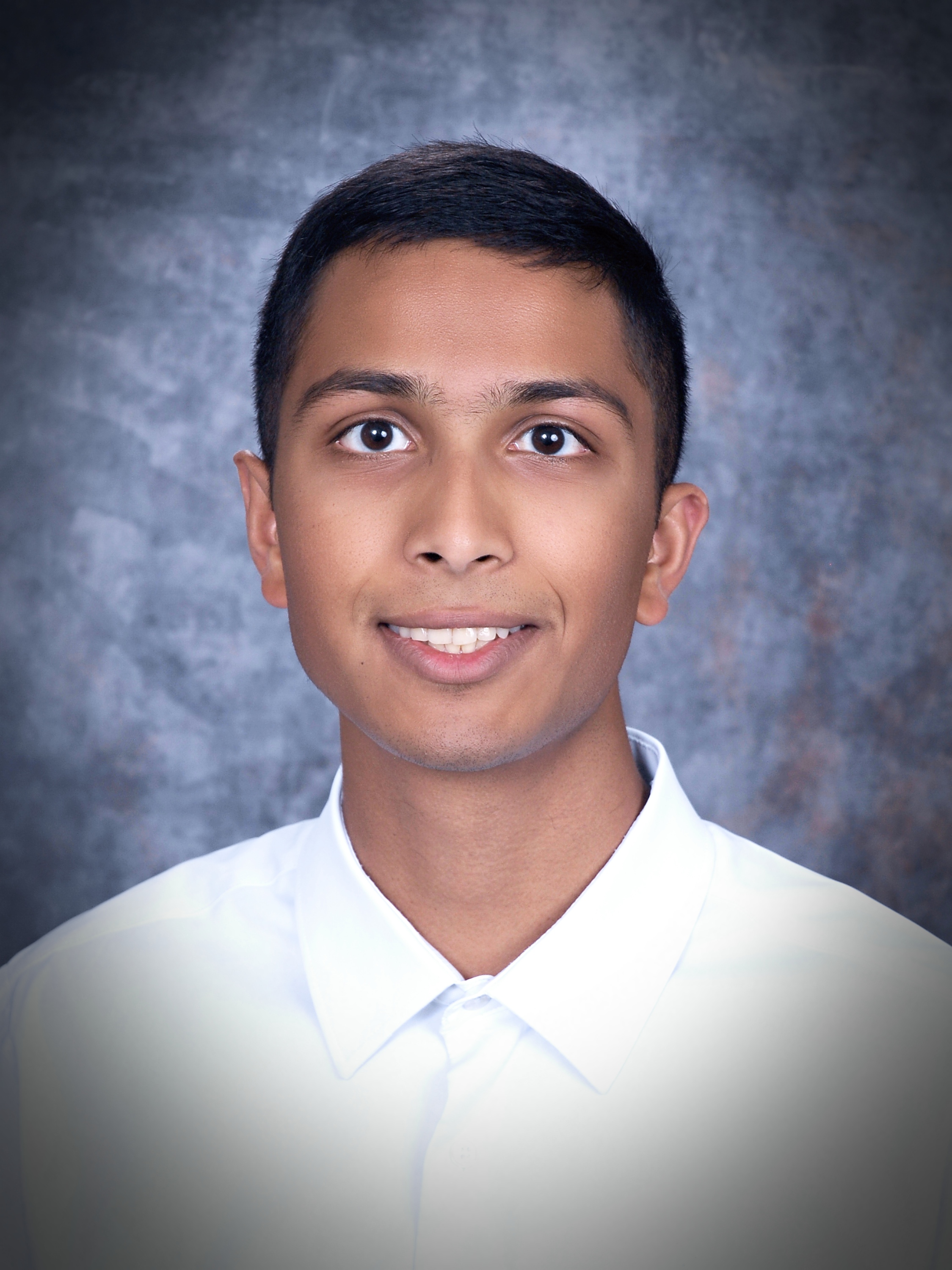
Profile picture
Publications
Preprints and papers.
- Model routing (coming soon)
- Model collapse (coming soon)
- Mitigating reward hacking (coming soon)
- Post-generation verification via statistics (coming soon)
- Conformal Factuality with Learned Structure (submitted)
- Risk-Controlled Post-Processing of Decision Policies (NeurIPS 2026)
- Foundations of Top-k Decoding for Language Models (NeurIPS 2025)
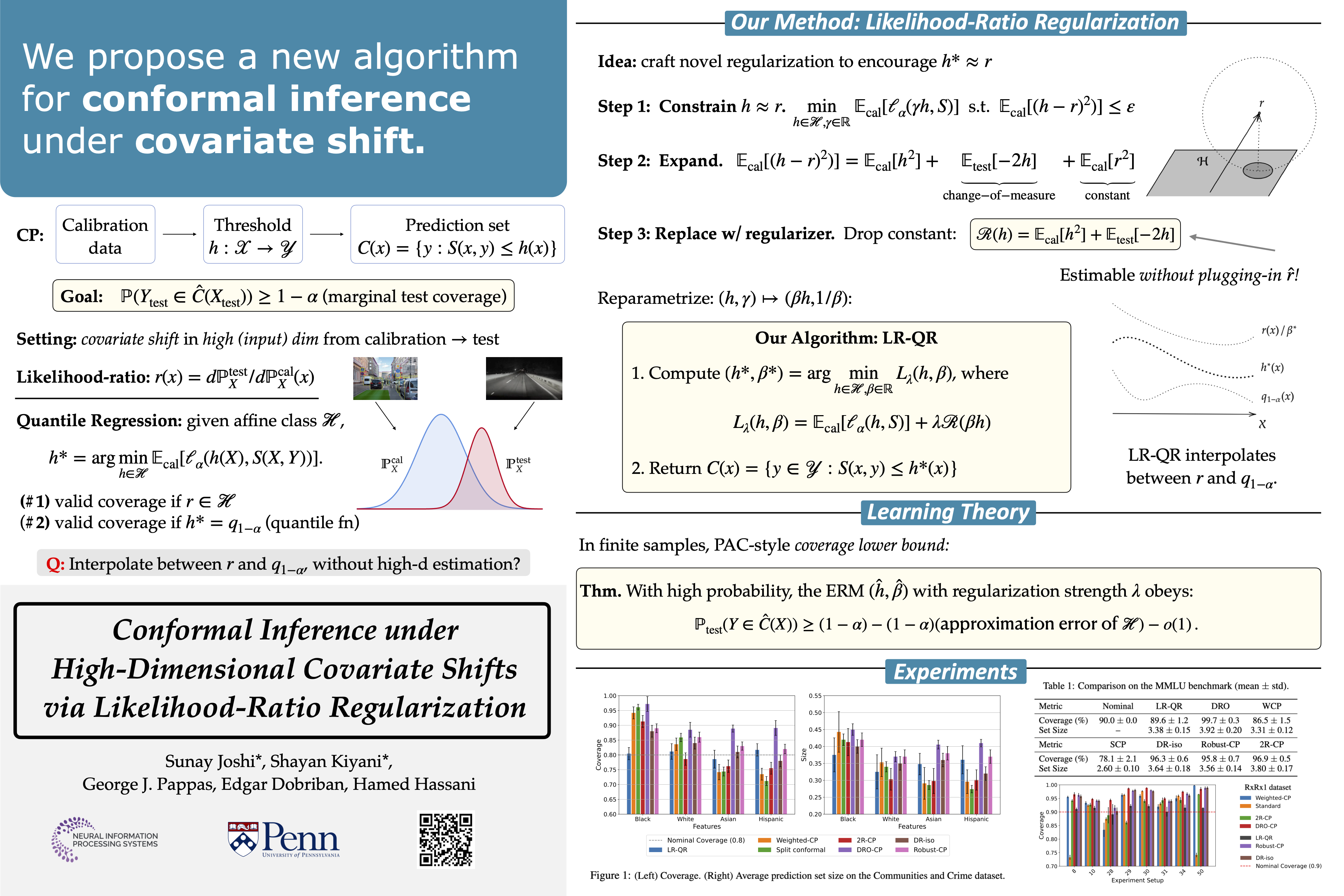
- Conformal Inference under High-Dimensional Covariate Shifts via Likelihood-Ratio Regularization (NeurIPS 2025)
- MultiRisk: Multiple Risk Control via Iterative Score Thresholding (JASA, R&R)
- Anomaly detection in spatial transcriptomics via spatially localized density comparison (Bioinformatics 2025)
- Navigating the Landscape of Fear (preprint)
Presentations
- Risk-Controlled Post-Processing of Decision Policies (poster, NeurIPS 2026, Sydney)
- Risk-Controlled Post-Processing of Decision Policies (poster, STAI-X 2026, Cambridge)
- Conformal Inference under High-Dimensional Covariate Shifts via Likelihood-Ratio Regularization (poster, NeurIPS 2025, San Diego)
- Various Forms of Preference Optimization (presentation, STAT 9911, March 2025, UPenn)
- Alignment of Correlated Random Graphs (presentation, Senior Thesis defense, Spring 2024, Princeton)
- Intro to LLM Reasoning (presentation, Dobriban reading group, January 2025, UPenn)
- Summary of Undergrad Work (presentation, January 2024, virtual)
Notes
Things I wrote, some incomplete.
(More annotations are coming soon. For a few files, I include an Overleaf link; but most are PDFs, because I don't see myself frequently editing them.)
Math
- ICM and STAI-X 2026 Notes
- Advanced Calculus by Prof Dafermos
A collection of simple lemmas that are frequently used in proofs in Fourier analysis, when developed using Riemann integration.
- Fourier Analysis by Prof Dafermos
A summary of what we covered in Fourier analysis.
- Measure Theory by Dr Glaudo
A summary of what we covered in measure theory and real analysis.
- Differential Geometry Notes by Prof Dafermos
An incomplete collection of notes from the differential geometry course at Princeton.
- Differential Geometry Problems by Prof Dafermos
These were our differential geometry homework problems. (Some, we never got around to solving.)
- Representation Theory Notes by Prof Laga
An incomplete summary of what we covered in our course on representation theory.
- Probability Review under Prof Shkolnikov
A summary of what we covered in probability theory.
- Stochastic Calculus Review under Prof Hubert
A summary of what we covered in stochastic calculus.
- Differential Inequalities for the Random Cluster Model under Prof Aizenman
My junior paper at Princeton: the derivation of a differential inequality that sheds light on the critical behavior of the Random Cluster Model (RCM) from statistical physics. The RCM is a dependent generalization of Bernoulli percolation, which has direct connections to the Ising and Potts models of ferromagnetism. The key input is a new concentration inequality for "decision trees" from the theoretical computer science community. I plan to elaborate on the broader role of differential inequalities in the study of phase transitions, as at first glance this might not be clear to the reader. I also plan to rewrite Section 4.1, whose exposition at present is a bit rushed.
- Conformal Invariance in Percolation under Prof Aizenman
One of the most striking results in percolation theory in two dimensions is conformal invariance, which states that when one takes an appropriate scaling limit of Bernoulli percolation on the integer lattice, crossing probabilities are invariant under conformal maps. This junior seminar paper explores implications of conformal invariance. In particular, I derive the crossing probability of an annulus up to constants.
- Random Field Ising Model under Prof van Handel
The study of disordered models in statistical mechanics is infamously challenging. The ultimate goal is to understand realistic models of magnets with impurities, like the Edwards--Anderson model; but at present, this is hopelessly out of reach. Here, we instead start with one of the simplest disordered models, the Random Field Ising Model (RFIM), and in this note I present an exposition of the proof that the RFIM does not exhibit a phase transition. The key idea is to treat the free energy as a function of the gaussian external field random variables, and then to leverage gaussian integration by parts and gaussian concentration. Once these are applied, bounding the free energy reduces to combinatorics. I plan on rewriting parts of this.
- Cryo-EM Notes under Prof Singer and Prof Moscovich
Incomplete notes on the math of cryo-electron microscopy.
- Multimode Value Iterations under Prof Gee and Prof Vladimirsky
Consider a partially-deterministic control problem where an agent navigates two-dimensional space, switching between multiple kinds of dynamics ("modes"). In this incomplete note, we analyze the convergence of value iterations for computing the value function, both in general, as well as under a monotonicity assumption on the mode transitions.
- Elliptic Curve Cryptography under Dr Katharine Woo
A summary of what I learned about elliptic curves and their applications to cryptography through Princeton's Directed Reading Program. Many of the cryptographic protocols listed in the report can be performed using an arbitrary abelian group. However, the group of rational points on an elliptic curve has a number of nice properties that can be leveraged.
- Elliptic Curve Cryptography Notes
The incomplete personal notes that were used to prepare the report above. The material on elliptic functions served as motivation for me to learn complex analysis.
- Congruence of Linear Symplectic Forms under Prof Tang
- Degenerate Turán Problem and Its Variants under Prof Jiang
- Math Colloquium: Prof Deligne
Incomplete notes from a talk on the hidden symmetries of algebraic varieties that went straight over my head.
- Math Colloquium: Prof Fefferman
Incomplete notes from a talk on interpolation and its relation to metric geometry.
- Math Colloquium: Prof Sarnak
Incomplete notes from a talk on the relationship between Diophantine equations and optimally navigating the special unitary group, with applications to the design of gates for quantum computing. (I am still trying to find my notes from this talk.)
- PUMaC Problems I Wrote
Statistics
- An Overview of Statistical Methodology by Prof Katsevich
A gentle overview of the topics covered in the statistical methodology course at Penn, spanning linear models and their geometry, generalized linear models, statistical inference, resampling methods, model misspecification, robust statistics, the basics of multiple hypothesis testing, and quite a few interesting tidbits from the history of statistics (whose early days seem particularly messy and controversial compared to other parts of the mathematical sciences).
- Mathematical Statistics Review under Prof Cattaneo
A summary of what we covered in mathematical statistics.
- Mathematical Statistics Notes by Prof Bhattacharya
Handwritten notes from the mathematical statistics course at Penn.
- High-Dimensional Asymptotics
Notes on high-dimensional statistics, including the basics of random matrix theory and universality.
- Statistical Physics for ML
A leisurely overview of topics in equilibrium statistical mechanics, with an emphasis on spin glasses, and with an explanation of how such concepts relate to modern problems in high-dimensional statistics and optimization.
- Estimation in Ising Models under Prof Bhattacharya
An exposition of results concerning the estimation of the inverse-temperature and external field in Ising models. Maximum likelihood estimation is intractable in this setting due to the usual difficulties (?) posed by the partition function. Luckily, the maximum pseudolikelihood estimator is consistent and achieves low asymptotic variance. Taking a step back, I find this problem a bit unnatural from an applied perspective.
- VAEs and the EM Algorithm on Dwip's Blog
A blog post Dwip and I wrote about variational autoencoders, an early form of generative AI.
- Diffusion Models
An incomplete overview of diffusion models, and the related theory of stochastic localization. Since writing these notes, I've greatly clarified my understanding of stochastic localization with the help of Shervin Khalafi, and plan on updating the file accordingly.
- Quantifying single-cell differential abundance with density difference estimation on manifolds under Prof Chitra, Dr Gold, and Prof Raphael
- Power-Law Graph Alignment under Prof Sly
The subset of my senior thesis that does not appear in existing papers. My broader thesis was on the alignment of correlated random graphs. Graph alignment algorithms can be used to positive ends (aligning protein--protein interaction networks), as well as to less positive ends (deanonymizing social networks).
Economics
Reflections
- Ruminations on AI Safety
Many mathematicians have begun to think seriously about AI safety, recognizing both the sea change taking place in their native fields, as well as the practical urgency of alignment. In this file, I record some of my preliminary thoughts.
- Perspective on Future of Papers
A personal perspective on how the academic publishing system in applied mathematics should evolve in this disorienting new era of superhuman AI.
- Perspective on Rating One's Own Papers
As a beginning graduate student, one aspect of academic culture that I found particularly disorienting was the tendency for all researchers to sell their latest paper as "the next big thing". (The advance of AI has only served to exacerbate this problem, in my experience.) In reality, most of a researcher's scholarly output serves merely to fulfill one of many obligations (either to a grant that funds their lab, or to students who must be trained by working on simple research problems), and such work has no ambition of changing the world. Of course, this doesn't stop researchers from overselling their papers, due to various perverse incentives that exist. In this incomplete note, I brainstorm schemes to address this problem, taking inspiration from Prof Su's "rank your own paper" mechanism for improved peer review in ML conferences. I first imagine an ideal world where tenured researchers are honest and attempt themselves to construct (absolute, not relative) scores for each of their own papers. I then acknowledge that such a system is extremely unlikely to take hold in academia, even among researchers with job security; and as a result, propose a scheme to estimate the unobservable quality of a given lab's papers based on observable factors, like the venue it is submitted to, whether or not it is featured on the lab website, the amount of social media promotion that was attempted, and so on. The goal is not at all to denigrate particular papers, but simply to help new researchers obtain a "calibrated" view of the research literature.
- Letter to Freshman Me
Recently, a freshman at Princeton wrote to me, asking what I do and how I got here. I'm not sure if he was impressed by or dismayed at my path through life thus far, but I gave him my advice, with the wisdom afforded by two long years outside of the orange bubble. I think some points apply pretty broadly.
Math Links
Things written by others about math; which I've read, am reading, or will read.
Math
- Princeton Lectures in Analysis by Prof Stein and Dr Shakarchi
- The Definition of Numerical Analysis by Prof Trefethen
- A First Course in the Numerical Analysis of Differential Equations by Prof Iserles
- Numerical Linear Algebra by Prof Trefethen and Prof Bau
- Representation Theory Notes by Prof Laga
- Probability in High Dimension by Prof van Handel
- Introduction to Bernoulli Percolation by Prof Duminil-Copin
- Open Problems in Mathematical Physics by Prof Aizenman
- Mathematics of Data Science by Prof Bandeira, Prof Singer, and Prof Strohmer
- The Mean-Field Dynamics of Transformers by Prof Rigollet
- Math of Cryo-EM by Prof Singer
- Foundations and Trends in Optimization, edited by Prof Donoho and Prof Candès
- Foundations and Trends in Communications and Information Theory, edited by Prof Mazumdar
- SolveAll by Edgar
Statistics
- History of Statistics
- Theory of Statistics by Prof Candès
- Maximum Likelihood: An Introduction by Prof Le Cam
- Semiparametric Estimation Overview by Prof Kennedy
- Hypothesis testing with e-values by Prof Ramdas and Prof Wang
- Theoretical Foundations of Conformal Prediction by Dr Angelopoulos, Prof Foygel Barber, and Prof Bates
- Statistical Optimal Transport by Prof Chewi, Prof Niles-Weed, and Prof Rigollet
- Statistical Physics Methods in Optimization and Machine Learning by Prof Zdeborová and Prof Krzakala
- Graphical Models Concepts in Compressed Sensing by Prof Montanari
- Community Detection and Stochastic Block Models: Recent Developments by Prof Abbe
- A Selective Overview of Deep Learning by Prof Fan and others
- Statistical Perspective on Diffusion Models by Prof Montanari
- Eleven Grand Challenges in Single-Cell Data Science by Prof Raphael and others
- The Visual Display of Quantitative Information by Prof Tufte
- Foundations and Trends in Machine Learning, edited by Prof Roth and Edgar
- Foundations and Trends in Statistics, edited by Edgar
- Edgar's Educational Materials
- Prof Mei's Lecture Notes
- Hamed's Tutorials
Economics
- Math Courses by Prof Sargent
- QuantEcon: resources to help people with a math background get started in quantitative economics research.
Seminars
- International Seminar in Selective Inference
- FOLDS Seminar
- ASSET Events
- Wharton Statistics Seminars and Conferences
- UPenn AI Safety Student Seminar
- IAS Computer Science and Discrete Mathematics Seminar
- Wilks Seminar
- PACM Colloquium
- Princeton Events
- Oskar Morgenstern Memorial Seminar
- Econometrics Lunch
- Money Macro Lunch
- Econometrics Seminar
- Micro Theory Lunch
- Paul M. Mazur Macro Seminars
Places
- Simons Institute for the Theory of Computing
- Flatiron Institute
- Center for Computational Mathematics
- Simons Laufer Mathematical Sciences Institute
- Institute for Computational and Experimental Research in Mathematics
- Centre national de la recherche scientifique
- Institut des Hautes Etudes Scientifiques
- Institut Henri Poincare
- Mathematisches Forschungsinstitut Oberwolfach
- Max-Planck-Institut für Intelligente Systeme
- Max-Planck-Institut für Softwaresysteme
- Indian Statistical Institute
- Institute of Mathematical Statistics
- Econometric Society
- Société Bachelier de Finance
- National Bureau of Economic Research
- Institute for Advanced Study
- Princeton Math
- Bendheim Center for Finance at Princeton
- Princeton Language and Intelligence
Blogs
- Dwip's Blog
- Behrad's Blog
- Davis' Blog
- Will Underwood's Blog
- Nathan's Writing
- Alex Robey's Blog
- Alex Zhang's Blog
- Terry Tao's Blog
- Prof Bach's Blog
- Berkan's Blog
- In the Key of Strawberry by Arnold Steinhardt
- Alan's Blog
- Zhehang's Blog
- Prof Mireshghallah's Blog
- Prof Diebold's Blog
- Roc Armenter's Blog
- Amir's Astrophotography Collection
- Prof Tan's Blog
- Prof Strogatz's Podcast
Inspiration
Math
- Inspirational Interview 3: Prof Elias Stein (Science Lives)
- Inspirational Interview 4: Prof Yves Meyer (Abel Prize)
- Inspirational Interview 5: Prof Lennart Carleson (Abel Prize)
- Inspirational Interview 6: Prof Talagrand at Norwegian Academy
- Inspirational Interview 7: Prof Yakov Sinai (Abel Prize)
- Inspirational Interview 8: Prof Srinivasa Varadhan (Abel Prize)
- Inspirational Interview 10: Dr Jim Simons with Numberphile
- Jim Simons, Businessman and Mathematician — IHES
- Fields Medal to Prof Mirzakhani
- Fields Medal for Prof Duminil-Copin
- Cédric Villani: En route Médaille Fields (2010)
- What's So Sexy About Math? by Prof Villani
- The Joy of Math by Prof Villani
- Théorème vivant by Prof Villani
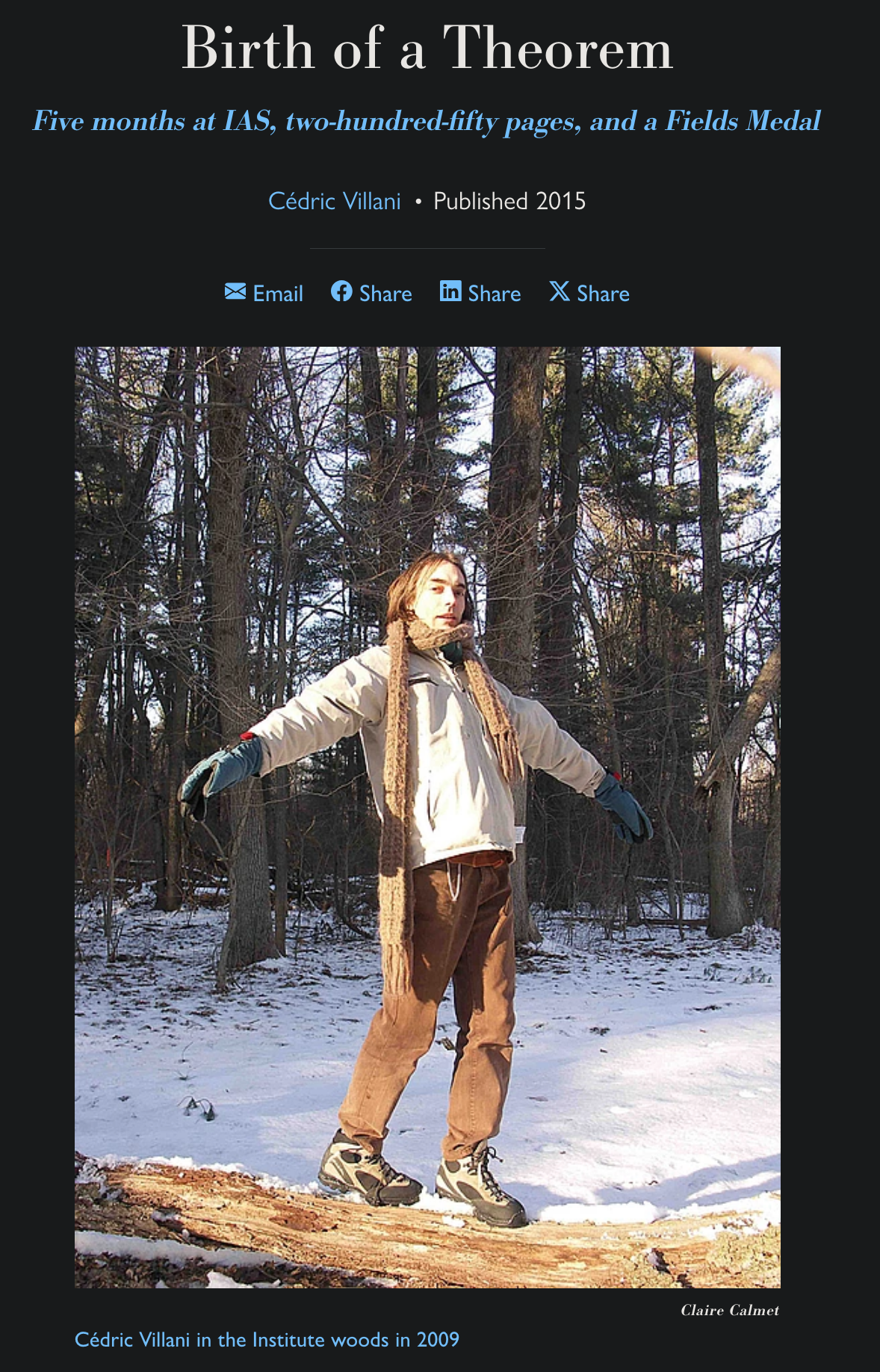
- Birth of a Theorem by Prof Villani at IAS
- Mathematics: Beauty vs Utility — Numberphile
- Hardy-Littlewood Rules
- Mathematica by Dr Bessis
- Music on a Clear Möbius Strip
- PaganiniBench for physical AI
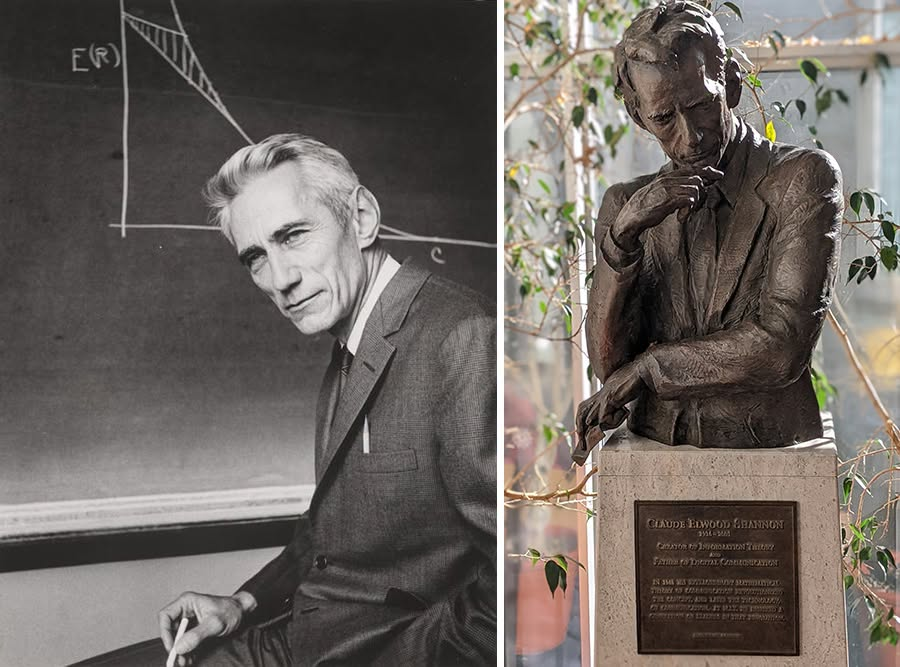
- Inspirational Documentary on Claude Shannon
- Inspirational Documentary about John von Neumann
- Inspirational Interview 11: Warren McCulloch at his home
- Inspirational Interview 12: J. Robert Oppenheimer at IAS
Statistics
- Inspirational Interview 1: Prof Donoho at HKUST
- Inspirational Interview 2: Prof Donoho at National University of Singapore
"At times I practically lived in the computer room almost 24 hours a day. I remember very clearly the room — named after Princeton statistician Sam Wilks. There was an oil painting of Wilks, the minicomputer, Wilks' personal books, the old-fashioned teletype terminals, the fancier pin writer terminals, the tape drives, the clackclack, buzz-buzz sounds everything made. I remember all the strange things that came with staying up late at night working on the computer in this place. Sometimes the computer users held "afternoon tea" at 3 am in the Math lounge!"
- David Donoho: Pioneer of Data Science and Mathematical Foundations
- E-Mail M-words by Prof Donoho
- Carl Friedrich Gauss Prize 2018: Prof Donoho
- Inspirational Interview 9: Charles Stein for Statistical Science
- Memorial: Charles Stein
- Memorial: Lucien Le Cam
- The Lady Tasting Tea: How Statistics Revolutionized Science in the Twentieth Century by Prof Salsburg
- The Thinking Eye by Prof Tufte (MIT Sloan Sports Analytics Conference, 2015)
Economics
- Inspirational Interview 13: Thomas Sargent at the Federal Reserve Bank of Minneapolis
- Lunch and Conversation with Prof Sargent at UChicago
- What Economic Researchers Do by Prof Sargent
- Lectures on Macroeconometrics by Prof Sargent and Prof Sims in Sweden
- Inspirational Interview 14: Christopher Sims at the Federal Reserve Bank of Minneapolis
- Information Theory in Economics by Prof Sims
- Inspirational Interview 15: Michael Woodford at the Federal Reserve Bank of Minneapolis
- Inspirational Interview 16: Prof Lars Peter Hansen
- Climate Risk by Prof Hansen and Prof Diebold
- Inspirational Interview 17: Michael Lewis on The Big Short, High-Frequency Trading, and the Modern Financial Industry at UC Berkeley Haas
- Inspirational Interview 18: Michael Lewis on The Undoing Project at 92NY
- My Economist Father by Alethea Black
"He liked philosophy, and he and my mother named me Alethea, the Greek word for truth. For years I believed he was tipping his cap to the idea of absolutes and would cheerfully say as much at parties. Then one day my mother overheard me and said: 'No. We got your name from a TV show'—it was a guest actress in 'Judd, for the Defense.' I laughed, humbled, and as I did, I could have sworn that somewhere, far from the world’s equations and signs, far beyond the manufactured clouds and flaming toasters, way out yonder where light has no speed, my father was laughing, too."
Resources
Things that may be helpful at all levels.
- Revision Organizer (coming soon)
- Brainstorming Ideas Visualizer (coming soon)
- Joe Holbrook Memorial Math Competition
- BCA Math Team
- National Science Bowl
- Modeling the Future Challenge
- Princeton University Mathematics Competition
- Simons Summer Research Program
- US Physics Olympiad
- American Mathematics Competitions
- MIT PRIMES
- Math REU Programs
- Math mentoring and community resources: Princeton DRP, Penn DRP, Princeton Math Club and community/mentorship, and Princeton's Life in Fine Hall Committee
- Fellowships and Grad School Advice by Prof Willett
- Stanford Science Fellows
- Stein Fellows
- Miller Fellows
- Norbert Wiener Postdoc
- Eric and Wendy Schmidt AI in Science Fellowship
- Kempner Research Fellows
- Simons Junior Fellows
- Rousseeuw Prize for Statistics
- COPSS Presidents' Award
- Fischer Black Prize
- Sveriges Riksbank Prize in Economic Sciences in Memory of Alfred Nobel
- Ross Mathematics Program
- Mentoring Möbius
- Leiden Declaration on AI
- STAI-X, a new conference model for stats-x-AI
- Penn AI Foundations Group
- Peregrine Collective
- Heterodox Academy
- Open Hearts Cafe, Rittenhouse Square
I personally find that music, art, and exercise are three activities that help me be more creative in life in general, and at research in particular. Below are some resources that I've found useful.
- David Michie Violins in Rittenhouse Square
- Bergen Youth Orchestra, founded by Mr Minor
- Young Musicians Concert at Lincoln Center
- Princeton Sinfonia under Dr Ochs
- Adoration by Florence Price (Princeton Sinfonia, March 2021)
- Old Nassau (Princeton’s 2020 Virtual Commencement)
- Princeton Events
- Curtis Institute Student Recital Series
- Penn Latin and Ballroom Dance (PLBD)
- UPenn Running Club
- Philadelphia Runner
I love educational materials that combine science and art (especially animation). I think it'd be great if more scientists and artists teamed-up towards this purpose. Check out some examples below.
Outreach
- Undergraduate Course Assistant for MAT340: Applied Algebra at Princeton, taught by Prof McConnell
- Mentor for UPenn Math Directed Reading Program
- Volunteer/Member, GETUP-UAW Local 5124 at Penn
- Applied Math Rep for SASGov
- Student Volunteer, ICML 2026 Workshop on AI4Research
- Organizer, Dobriban Statistical Machine Learning Reading Group 2024-25
- Organizer, Hassani Group Running Club
- (Tentative) Member, Sargent Reading Group at Wharton 2026-27
- Co-Advising Chair with Sara Ansari, Princeton Mathematics Club 2023-24
- Problem Czar, PUMaC 2022, and PUMaC problem writer
- Co-Director with Sameer Pai of Joe Holbrook Memorial Math Competition, 2019
Awards
- NSF Graduate Research Fellowship Program, Honorable Mention (2024): National recognition for a meritorious application to NSF's graduate research fellowship program.
- Phi Beta Kappa (2024): Elected to the oldest academic honor society in the United States.
- Sigma Xi (2024): Elected to the scientific research honor society.
- Andrew H. Brown Prize, Princeton University (2023): Awarded by the Mathematics Department to outstanding juniors in mathematics.
- Class of 1861 Prize, Princeton University (2022): Awarded to the sophomore with the best record on the Putnam Examination.
- Shapiro Prize for Academic Excellence, Princeton University (2021): Recognizes outstanding academic achievement by undergraduates in their first or second years of study.
- William Lowell Putnam Mathematical Competition, Rank 150 (2021): An annual undergraduate mathematics competition organized by the Mathematical Association of America.
- USA Physics Olympiad, Silver Medalist (2019): A national high-school physics examination used in selecting the U.S. Physics Team.
- USA Junior Math Olympiad, Qualifier (2018): A national invitational mathematics competition focused on proof-based problem solving.
Artwork
My attempts at art, and things I find pretty. (Update: no longer being updated, see my Facebook for the latest.)